Cave Art - Week one, 26th September
This week's lecture was mainly about culture and cave art; culture is seen as a reflection of the society which it's made and art then reflects this culture.
The first pieces of cave art were created up to 30,000 years ago using various materials such as ochre, hematite, manganese oxide and charcoal which could be seen as early signs of technology. This technology has developed in art and now all pieces of art use technology as time has progressed, art, technology and humans have worked together more and more and now are closely linked.
There are still questions as for the reasons why this cave art was created: What were the reasons behind the artwork? Where the creators of the art creating it with the intention of people viewing it? These questions and others similar will never be answered now, however this could be seen as an advantage as it gives you the freedom to make the decision for yourself as to the reasons for the cave art. In my opinion there are 3 potential reasons for the creations:
1) Education - the artwork was created as a way of recording life as it was, it was created in a way that they suspected would be permanent allowing future generations to discover the art and allow it to educate of how life was then.
2) Statement of power - Many of the pieces are showing fighting and hunting scenes, often men v animal. By showing this it could be seen as the creators representing themselves as strong powerful people; this could then be seen as a warning to people of their power.
3) Expression - this is the least educational and logical reason of them all, however still very possible. Current art is often created as a form of expression; to reflect emotion for example, the cave art could have been created in the same way. Maybe it's as simple as they enjoyed creating it?


Egyptian, Greek and Roman Culture - Week two, 3rd October
Egyptian - Egyptians had a very strong infrastructure and architecture which creates myths that the people believe and live in like a narrative. These myths and stories of culture are passed on through word of mouth from generation to generation, this is a similar process to that of several countries.
The Egyptians art work was made in 2 ways: low relief work which is sculptures which have been built upon a wall yet carved into stone, this is slightly rounded and gives the illusion of depth and 3-D. The second was deep relief which is where the sculpture is much more like a free standing figure attached to a wall.
The work of the egyptians was often very stylized; all their human based work was styled on their "ideal looking human", so everything had perfect proportions and everyone had the same idea as to how people should look.

A low relief piece of Egyptian art

A deep relief piece of Egyptian art
Greek - Most of the Greek's work depicted power and strength.
This came across in particular in their buildings, for example the Parthenon; everything about this building is symbolic and means something for example the golden triangle at the top of the building, the number of pillars are the front of the building and the golden rectangle that is that shape of the building front itself. The Greek's were so desperate for their buildings to look powerful that they made the actual Parthenon itself slightly bent in shape so that when looked at with the naked eye the building actually looked straight.

The Parthenon, Rome, Italy
The Greek's also depicted power and in a similar way to the Egyptians had a vision of the "ideal human being" who was perfectly proportioned. This is proved in all their work of humans; all the humans limbs and aspects of their bodies were exaggerated in order to depict this perfection and power.

An example of an idealistic male statue
Romans - The roman's work was much more based around narrative and story telling than documentary work. Trajan's column is a prime example of this; this column was made using the low and deep relief technique that was used by the Egyptians. All around this column is the stories of Trajan's battles that he has fought, almost like a comic strip.


A specialist type of art work that the Romans created was the 'fresco' this is a painting which is made on someone's wall while the cement is still wet this is a very creative and unique idea which I think gives a very effective result.

A piece of fresco work
From this week's lecture it left me with a couple of questions in my head, questions that only time will answer and we will not live to find out the answers.
1) What will be left in 1000 years times from this culture?
2) How will it represent us?
Religious Art - Week three, 10th October
This week's lecture was on religious art and modernism. The Roman Empire was split into 2 sections Eastern which was the birth place of Byzantine art and Western, home of Gothic art.

Byzantine art was art from the 5th century onwards, it was seen as a influence to Eastern Orthadox states without them being a part of it. Byzantine art was also seen as iconic.
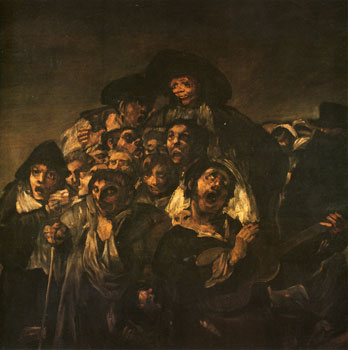
This is an example of a piece of gothic art. Gothic art was developed out of Romanesque art in the 12th Century led by gothic architecture.
Giotto was a very famous architect and painter from around this period, he was born in 1266/7 and died in 1337. He was t from Florence in the late middle ages and is generally considered to be the first in a line of great artists who contributed to the Italian Renaissance.

Another separation of art was low and high art; low art was seen as art that doesn't have much value therefore would not be such a loss if it was got rid of. On the other hand there is high art which is art of a high value which would be a great loss if disposed of. This separation is still in place today, some pieces of work from some artists are of a higher value than ones of other artists, but not only does it happen between artists, it happens within art works of a single artists as some of his works will be more popular therefore of more value than others.

Raphael became known as the artist who created a change in 2-D art; before this period a lot of artists were attempting to put perspective into 2-D art, however it was proving difficult and there are several examples of pieces showing this difficulty.

This is the piece of work of Raphael's that changed 2-D art; the perspective in this image is more of less perfect, the height of the people varies according to their distance away from the front and the patterns on the floor leading up to the building at the back are all in perfect perspective.

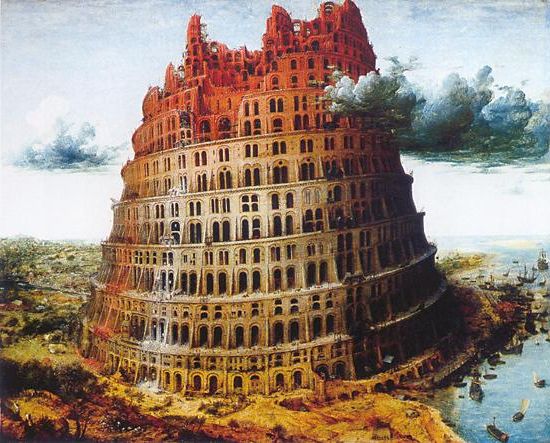
The Dog > Loyalty (Dog is a man's best friend)
His shoes > Sacred, important
Fruit > Wealth
Formal wear > Blessing
Red > Passionate
Brush > Good housewife
Symbols like these are used within pieces of art to tell a bigger story, although we will never be able to decode all of them correctly as we are not the ones that created them, we can decode enough of them to give ourselves an outline of what the artist wanted us to get out of the piece.
The Renaissance - Week four, 17th October
The major change to come out of this time period was the way in which we represent the world; this changed dramatically.
The Renaissance was split into 3 periods; early, high and low renaissance, each of which created totally different art and the development between them all is also very dramatic.EARLY RENAISSANCE:
The early renaissance mainly consisted of work based on the natural world and real life.
One of the most popular artists of the Renaissance and an artists that remains a favourite to this day is Leonardo da Vinci who at the time was also called 'The Renaissance Man' due to his influence on the Renaissance. Not only was Da Vinci a good artists but he was also known for his talent as a scientist and mathematician.
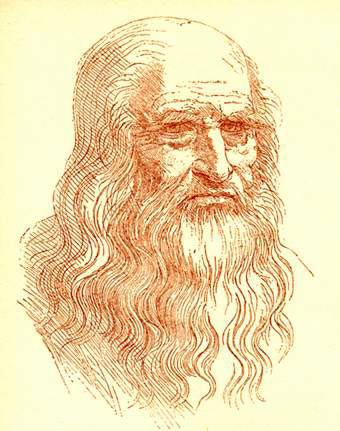
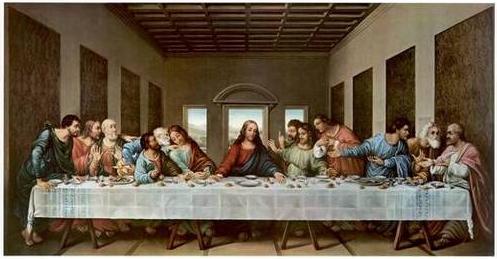
On of Da Vinci's most well known pieces is The Last Supper, not only is this a famous piece as it is a visual of a very important story of Jesus' last supper but for its perfect perspective; as well as the perspective of the room in the paining itself, the walls on the piece carry on in the same line of perspective to meet the walls of the building it's in.
The Mona Lisa is one of the most famous painting in the world, also created by Da Vinci. One of the reasons for its popularity is the mysteriousness of the image. Da Vinci purposely painted the eyes in a position that draw you in and follow you. It is well known that the British like to look and watch people but when looking at this piece it puts us at a sense of un ease as it is as though where ever we stand she is looking back at us. Also the position of the Mona Lisa in comparison to us is as though she is ever so slightly looking down on us, which could be seen as humility on the viewers perspective.


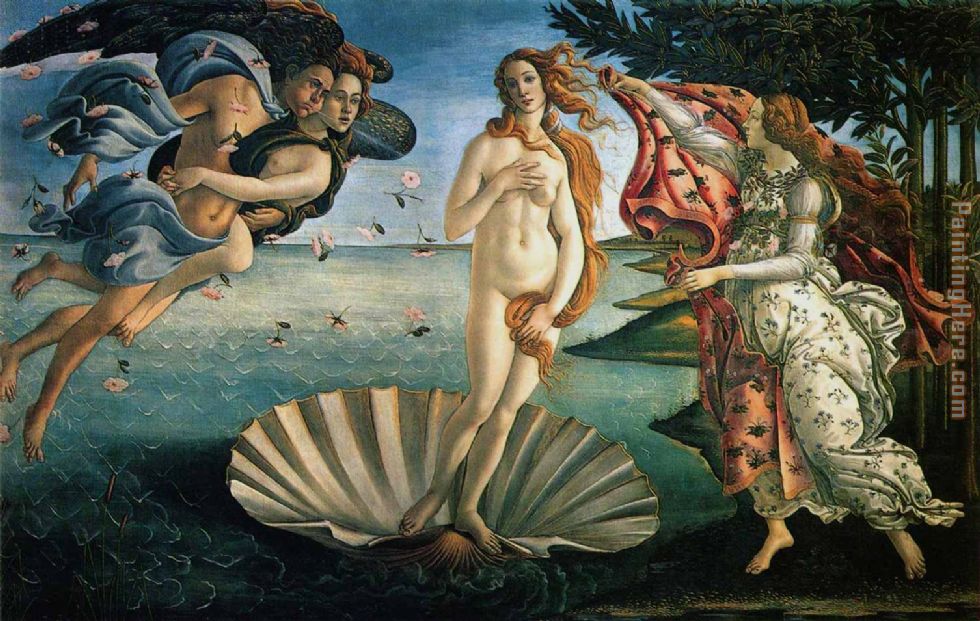
Sandro Botticelli was another famous artist of the early renaissance whos works include; Birth of venus and La Primavero
Not only was Da Vinci famous for his paintings but after he died it was discovered that he was also designing; some of his designs even included predictions of flying machines. Despite Da Vinci came up with many of these drawings and inventions none of them actually worked.
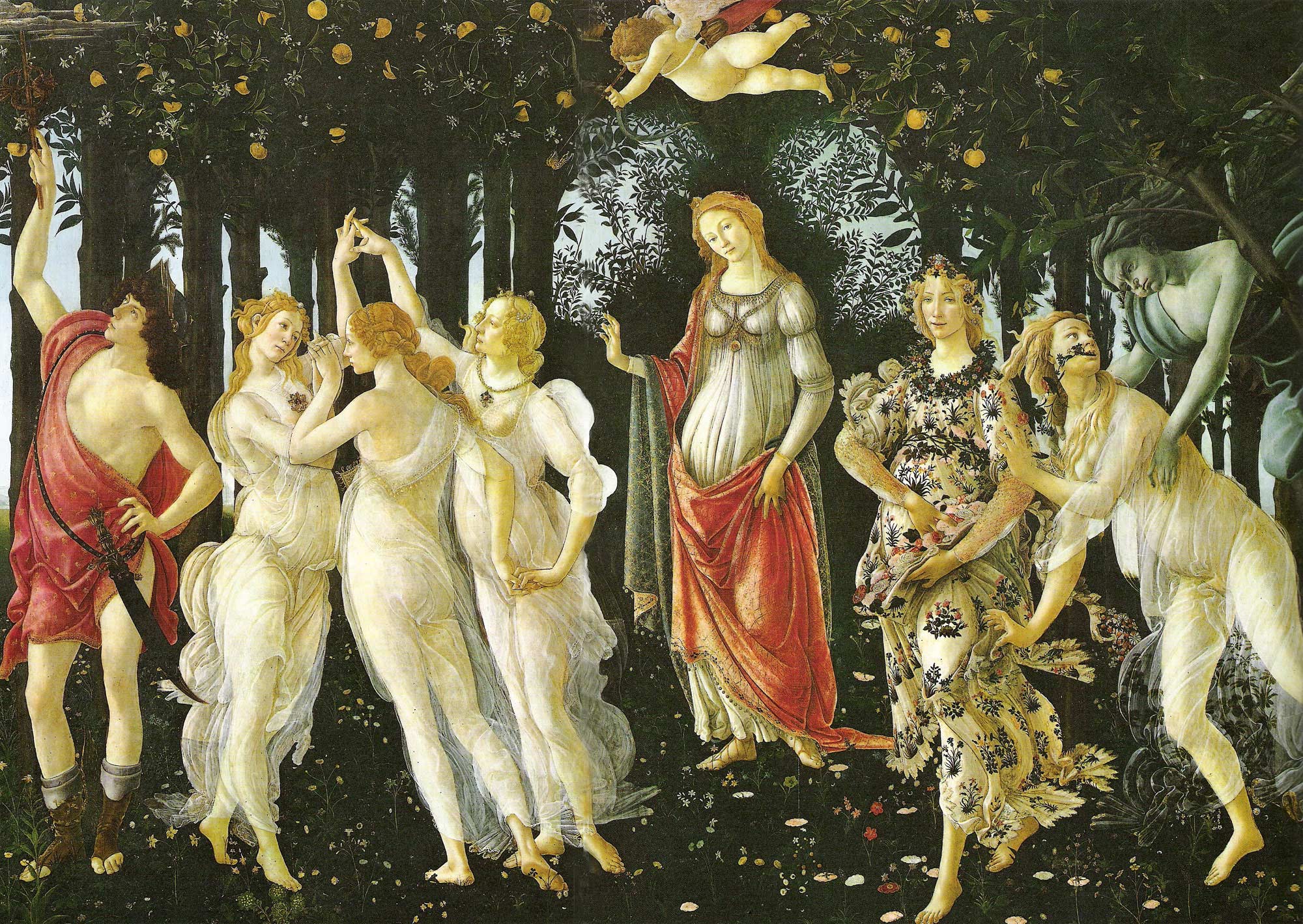
The story behind this piece (La Primavero) is that Flora, the naked woman to the right of the piece is being taken and turned into a goddess.
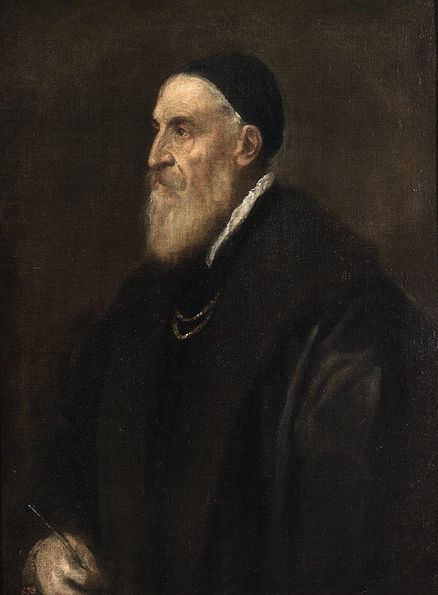
Titian
At the start of his career he was seen as a craftsman at time progressed they noted his skill and he became very valuable.
LATE RENAISSANCE (mannerism and exaggeration)
Michel Angelo not only created work in the early renaissance but in the late as well. Creation of Sun and Moon is a very famous piece to come out of the late renaissance, especially because of the exaggeration within the picture for example the character has one very oddly proportioned arm and despite the hands being at a different distance from each other they are both the same size.

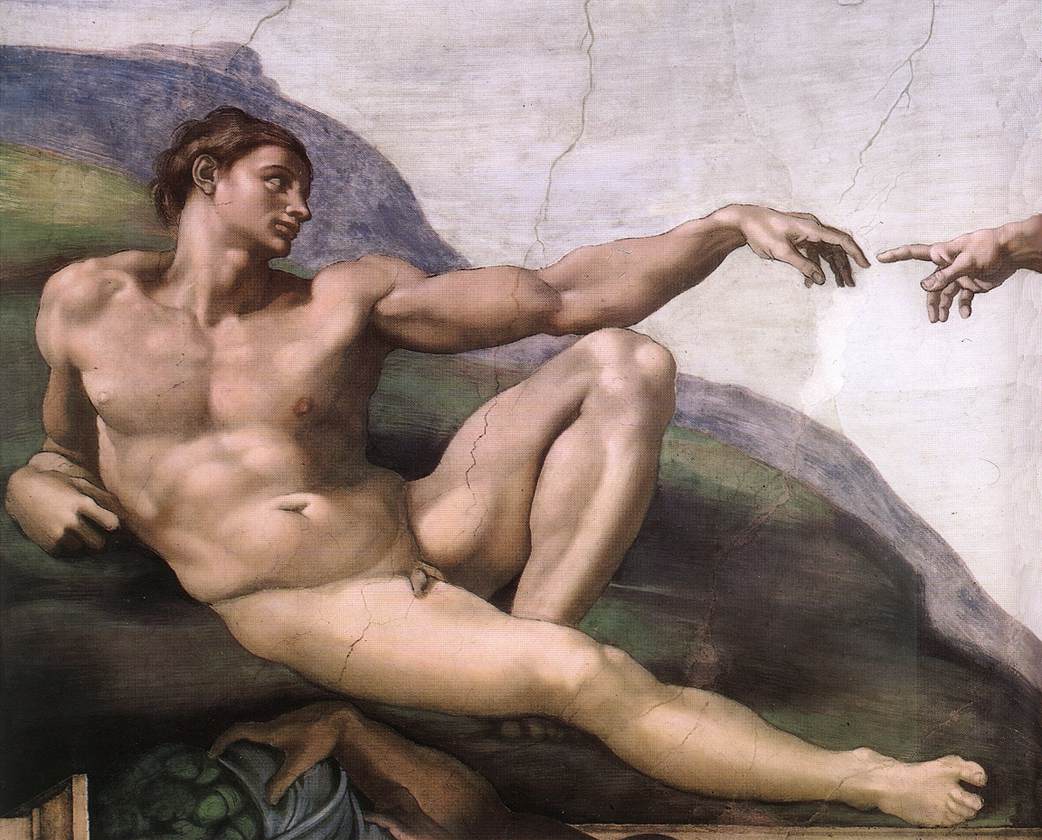
Another piece of Angelo's work which is famous for similar reasons is Adam of Sistine chapel; he has a very small head, a chunky body, one leg longer than the other.
Carravagio was another artists of the Late Renaissance, his actual name was Michel Angelo but due to the fact there was already a major artist with this name he chose to be names after the place he lived in, Carravagio.

Carravagio's work moved away from exaggeration much more realistic and down played. His work was very dark in subject, colour and lighting and dark in meaning. The above image shows St Thomas sticking his fingers in Jesus' wounds to see if they're real as if he is doubting it's Jesus Sleeping cupid, another painting of Caravaggio and in a similar way to the painting of Jesus it is very dark and has a dark meaning behind it. The painting is seen to represent love falling asleep, the dark side to love this is represented by over 50% of painting being black.

Baroque architecture - Trevi fountain, Rome. Augustusburg Palace. Rococo Queluz Palace. Ottobeuren Abbey


This was the time period between the Renaissance and Secular and Modern art
Romantics - Week five, 31st October
Johannes Vermeer was a very famous artist of this movement who specialised in interior scenes of the middle class, he was also a big believer of the idea that god is always around it's not something you "have to pay for"

Romanticism - Feel or movement but not a rigid movement
Sublime - Feeling of ore, something bigger than us
Theodore Gericault is famous for the painting the Raft of the Medusa which is a contemporary event; a ship got in trouble and the passengers were cut loose on a raft.
One of Vermeer's most famous paintings - The Girl With The Pearl Earring
Sublime - Feeling of ore, something bigger than us

Thomas Cole was the artist and creator of The Voyage Of Life (series of 4) which is a very dramatic, powerful and symbolic series of art work which show


Goya's Massacre became extremely famous as the painting was classed as the first piece of truly modern art, this is because what can be seen in the picture is what actually happened and how it was.

When cameras were invented artist's work changed to being made by a machine and the person behind it, some of Goya's work was based on events he witnessed himself which he had recorded then painted so effectively he had the same role as a photographer except rather than capturing the image at the time he was seeing it, he painted it from his recolections. This then led to the development of paintings moving from being very romantisiced to being more realistic as with photographs, the image was exactly how things were at the time and not an exaggeration.
The Voyage of Childhood - the main detail of the boat with the child and an angel on the water is there to represent the joy and innocence of childhood.
The Voyage of Life Youth - the main detail of the boat with the boy in leaving the shore with the angel watching represents the boy beginning to take control and have independance.
The Voyage of Manhood - the main detail of this painting is the evil spirits that are depicted in the clouds of the painting which show that now the boy has grown up he is facing the ups and downs of life.
The Voyage of Life Old Age - in a similar way to the voyage of life of childhood, the main detail is the man and the angel in the boat together again but this time it is to represent that the man has overcome lives trials and the angels are now descending.
Artist - Joseph William Turner


Turner's work had a theme of Impressionism which was a direct link to photography; it is an artist's opinion however, although it looks good you can't get a feeling of how it was to be there.
The development of photography was obviously a big movement, so much so it pushed art into impressionism as it was seen as the most realistic style of art to date.
Manet Dejeuner's impressionist painting however, caused up roar due to the naked woman in the painting due to the fact she is in a un classical context. By being in this context it makes you question the reasons behind her nakedness and focus on the fact she is naked rather than accepting it due to the context. This is a perfect example to the quote "context is key".

Another painting that caused a similar up roar is the Olympia painting which is directly related to Tishan's reclining nude shot. The woman in this painting is a prostitute; we can tell this by the ribbon that is around her neck. The reason behind the up roar is that she hasn't been asked to remove the ribbon and she hasn't removed it herself so she obviously isn't ashamed of it.

Monet's haystacks work is a good example of work that gives the audience a feeling of what it was like to be there at that exact time, this is done by the colours and sense of light used; you can sense the time of day and the mood and atmosphere of the time. The light in these paintings is the most important thing and is in general the most important thing when it comes to creating a sense of mood and atmosphere as it can tell you a lot about the time of day.


Van Gough was not only one of the most famous post impressionist painters but one of the most well known painters of all time. The insanity of his work could be seen as reflecting his personality which was known to be frantic which could also explain why some of his work looks quite expressionistic.


Work then began to change from impressionism to expressionism which was work that reflected what it was like to be there at the time. One of the first artist's to embrace this change was Degas who was most famous for his paintings of ballet dancers; the lighting in his paintings and the naturally of the situation created the realistic approach and created the atmosphere of the room.

Sheile was an artist that then fully embraced expressionism; his work was quite abstract although sense of emotion was still detectable.


If expressionism was to be nailed to one painting, it would be Scream by Edward Monk

Although the painting was initially seen as a person screaming, it is actually of a person reacting to a scream; they are covering their ears. Piercing screams of the insane have changed the landscape and make the sky come alive.


Modernism is the idea of prograssing to a Utopia.
William Blake however, apposed the idea of progress his work was more about symbolism and was much more traditional. "It's not progress, it's dynamic difference" was a quote of his to defend his opinion of modernism.


William Morris expressed the idea of the applied art; art is made not just for a gallery, it is made for use for example: for wallpaper. He was heavily into design and thinking about what you're doing, his work very heavily influenced by nature.


Art Nouveau is art created with the inspiration of the nature, exaggeration of Morris' work. nouveau was both hand made and machine made and was an inspiration to art/fashion and design.

Van Gough was not only one of the most famous post impressionist painters but one of the most well known painters of all time. The insanity of his work could be seen as reflecting his personality which was known to be frantic which could also explain why some of his work looks quite expressionistic.
- Cezanne was a painter famous for his landscapes in the south of France, similar to those of Monet.

- Death and the maiden - beautiful woman and death; a common theme within art
- Klimt - taught Schiele, figurative portrait mixed with expressive pattern

Trip to Bradford Media Museum - 3rd November
Donovan Wylie
Daniel Meadows
Red Saunders
From descent to establishment - Week six, 7th November
William Blake however, apposed the idea of progress his work was more about symbolism and was much more traditional. "It's not progress, it's dynamic difference" was a quote of his to defend his opinion of modernism.

Art Nouveau is art created with the inspiration of the nature, exaggeration of Morris' work. nouveau was both hand made and machine made and was an inspiration to art/fashion and design.
Art deco on the other hand was simplified and stylised designs, still affected by nature but were based more towards geometric shapes.


.png&sa=X&ei=62nKTp2zEYrfsgaDnMizBw&ved=0CAwQ8wc&usg=AFQjCNFNHqHDloW5UAm75ki9A51SCREDMw)


Bauhaus is a term for minimal design, it was the creator of the idea "form follows function" which means the function of an object and whether is works or not should be prioritised over how it looks, also "less is more".
- Bauhaus - art and design school

New ways of seeing - Week seven, 14th November
- Expressionists - schiele, klimt - painting to show how it felt to be in a location (the mood)
- Kandinsky - still landscape like expressions to abstraction (removed from reality)

- Composition 8 - natural forms more stylised

- Mondrian - red tree - looks like a tree, late expressionist painting

Artists then began a process of deconstructing what we see and simplifying to the basics as a form of expressionism.
Paul Klee is a good example of this; his work was very stylistically varied (he tried lots of different things), his work was more about mark making. Although his works were observations ,they were more on an abstract version of the reality.


Cubism was divided into 2 parts:
Paul Klee is a good example of this; his work was very stylistically varied (he tried lots of different things), his work was more about mark making. Although his works were observations ,they were more on an abstract version of the reality.
- Braque and pablo picasso came together to form cubism
Cubism was divided into 2 parts:
The 1st part was analytical cubism this consisted of transferring a 3-D image onto a 2-D plane, this mainly consisted of drawing things from varying perspectives. A good example of analytical cubism would be Braques Violin Mondian, the image is of a deconstructed violin.
Guernica painted 'Art from outside of the west blue period' which is a piece he painted while he was suffering from depression after a death which is why everything is painted with a blue hue.

Guernica was blown up by Hitler as a test of his weapons/carpet bombs, this painting is very symbolistic of this event: bull - spain, eye - all seeing eye of god, newsprint - he wasnt there he has seen it through newspaper, black and white - everyone only saw it in black and white (newspaper)
The 2nd phase of cubism was synthetic cubism which was the bringing together of real objects to create one piece collage.

Dada - art movement: collage, montage, art challenging everything

By moving the urinal from a toilet to a gallery changed it, by changing the context of an object it can also change the function of it. When the urinal isn't in a bathroom context it doesn't have the function of a urinal, therefore it isn't a urinal. By changing the context, it makes you question was it really is. It also makes you ask yourself bigger questions such as what the process of art is?


Surrealists tried to find a way of getting straight to the ID as they thought that's where creativity came from.
Alot of his images suggest a narrative for example the New York movie piece of an usher at cinema; you are drawn to the usher as not only is she given a separate light but she is in a very meaningful, thoughtful position.
- Marcele Duchamp - Nude: looking at time, in response to WW1 set up with a few artists "anti-art" group
Dada - art movement: collage, montage, art challenging everything
- Fountain by Mutt (1917) - single most important piece of art of all time

Surrealism - Week eight, 21st November
- Freud/Jung - almost single handedly creating phsycology
- Super ego - explains differences in behaviour and why we're not all the same
- Super ego communicates with the ego
American Art - Week nine, 28th November
- Joseph Cornell (pre-war period) - assembly pieces, found images, bits of text
- Edward Hopper - creates a good atmosphere in a similar way to surrealists


- Early Sunday the good capturing of light in this painting makes you feel you are there with the character which is quite surrealistic.
- Gas - captures spirit of America

- Lights at two lights is a painting that is extremely close to photography, the reason for this is because of its radical cropping off the top of the lighthouse; this kind of cropping had never been done in a painting before.

- Nighthawks - most referenced painting in the popular culture for example in the simpsons

- Time of the 2nd world war - Jason pollock - action paintings/paint drops which could be seen as representing blood splatters and drops due to the time period it was painted.

- Mark Rothco - Colour field paintings; a series of paintings, all of the same design with the changing of colours in each to represent the changing of colours throughout the seasons.

- 1950's britain peter blake - challenging what art is about
- self portrait - not typical of the time - casual clothes covered in popular culture badges

Andy Warhol was a very famous artist of the pop art movement and was well known for his obsession with celebrity.


The famous bright paintings of Marilyn Monroe which due to the colours could easily be seen as gay/happy is the total opposite of Marilyn Monroe's life as she actually led a very tragic life.

The same could be seen of his death and disaster series, despite the images being of fatal crashes and injuries there images are coloured.


Roy Lichtenstein 's work had 2 sides: child comics which influences the style of his and love, relationships and war which is reflected in the narrative behind the images.


Claus Oldenburg was an artist famous for challenging everyday objects and making them seem really important by creating who's monuments out of them.


After pop art came the movement op art

Land Art - Andy Goldsworthy challenges the idea that art is permanent, moving art out of the gallery challenges it being art, no technology used just manipulating the world. The only time you see his work is in books or in photos in a gallery because his work decays and disappears over time due to it being made out of natural subtances.
- Soup - the same can but different; this could be seen as a representation of celebrities, they all have the same status and initially are doing the same thing however, the only difference is their appearance.
The same could be seen of his death and disaster series, despite the images being of fatal crashes and injuries there images are coloured.
- The process of seeing - Bridget Riley
Brit Art - Week ten, 5th December
- In built obselecence - not a movement, more of a way in change of thinking
Marcus Harvey allowed for his work to be given bad press as it allowed more attention to be given to the work. His work was given bad press due to the fact he used children's handprints to give the message of how terrible Mayra Hindley was as he killed and abused children, however it was a misunderstanding of the general public.
James Reilly created a series of small portraits with blacked out faces contraversy of it being a representation of paedophiles next to children when actually the blacked out faces are family members who died and reilly can't remember what they looked like.
Jenny Saville received bad press for challenging the female form and what female beauty is and how it is viewed by us.
Sarah Lucas; as a practitioner her work is flawed, her work is a visual seduction - you want to keep looking at her work.
Tracey Emin - Everyone I've Slept With (1963-1995) received very bad press for her womblike tent that inside hd the names of all the people she'd ever slept with. The piece was referred to as slut art when infact it was just people she had slept in the same bed as rather than had sex with.
The Voice of a Modern Female was an unmade bed smothered in used condoms and tampons etc which is an image of women people don't see or imagine. It received controversy for the honesty of it.
Photography - 12th December

Henry Fox Talbot - produced positive and negative photography but his work was mainly negatives. His were the first photographs that could be produced again and again due to the fact they were mechanically taken. His images enabled people to share and see the world more, what it really looked like rather than an artist's interpretation in the form of a drawing.
The Voice of a Modern Female was an unmade bed smothered in used condoms and tampons etc which is an image of women people don't see or imagine. It received controversy for the honesty of it.
Photography - 12th December
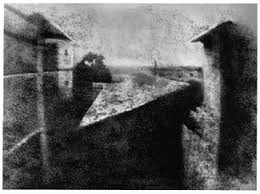
Niepce - earliest photograph known surviving (1826) everything hanged after this image, we could mechanically record the world. The image had an exposure time of 8 hours, the exposure time was so long there islight on both sides of the building as the sun moved over head during the exposure period.
Daguerre (1837 - still life), 1838 - first photograph containing a human, long exposure time eradicates people as they dont stay still long enough
Henry Fox Talbot - produced positive and negative photography but his work was mainly negatives. His were the first photographs that could be produced again and again due to the fact they were mechanically taken. His images enabled people to share and see the world more, what it really looked like rather than an artist's interpretation in the form of a drawing.
